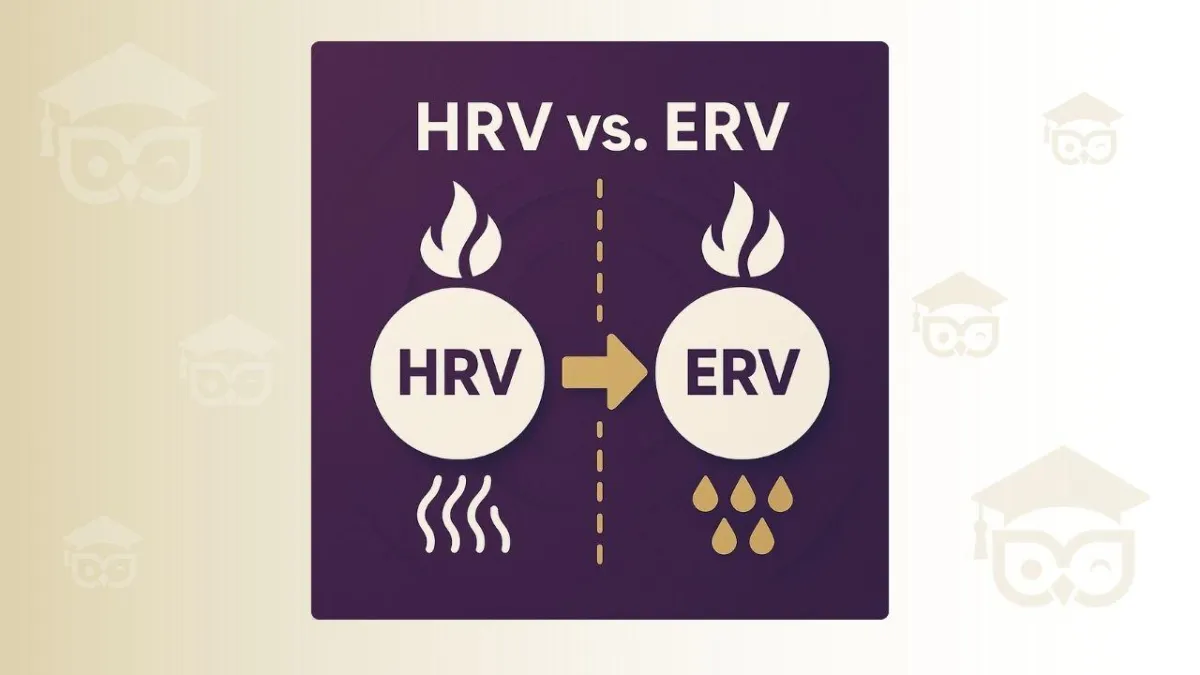
HRV vs ERV
Your Quick Win Summary
Same box, different superpowers—meet the HRV–ERV difference.
Choose How You Want to Learn:
Flexibility for different learning styles — all blocks optional, use one or all, you choose.
🎧 Listen on the Go:
Audio version for your commute
☕ Coffee Chat with Your Mentors:
Join senior trainers Julia and Daniel as they share insider tips you won't find in textbooks. Real talk about what actually works on-site.
🎙️ Hear It From Aime & Aiden
Our AI podcast hosts break this down into bite-sized insights. Perfect for your morning walk.
HRV vs ERV — The Simple Geeky Truth
Last time, we explored airtightness vs ventilation. You discovered why mechanical ventilation with heat recovery isn't a luxury. It's control. It gives you fresh, filtered air without gambling on leaky gaps or weather. Now you're facing the big question: HRV or ERV?
Same-looking box. Very different superpowers. Let's break it down.
Why You Ventilate (And Why Airtightness Matters)
You want healthy indoor air. That means removing cooking smells, potential mould spores, chemical off-gassing, and fine particles. Then replacing them with outdoor air that's been filtered and temperature-adjusted.
Airtight building fabric lets you control this process. Random ventilation through cracks? That's not control. That's whatever the wind decides. During bushfire smoke in Perth, dust storms in Adelaide, or city smog in London, that randomness bites hard.
Building physics confirms mechanical ventilation with filtration gives you the steering wheel. You decide what comes in. You decide when. You decide how much.
Meet Your Two Options
HRV = Heat Recovery Ventilation. Think of it as a heat handshake. Temperature swaps between exhaust air and supply air. Heat transfers. Moisture doesn't. You keep your heating and cooling energy instead of throwing it out the vent.
ERV = Energy Recovery Ventilation. Think of it as a full conversation at the door. It transfers both heat and humidity between airstreams. Like a smart bouncer checking both ID and the guest list. Temperature and moisture get managed across the heat exchanger.
Bypass mode. When outdoor air is already perfect, you skip the exchange completely. Fresh air flows straight in. No wrestling with temperature or moisture. Just the good stuff sliding through.
That's your toolkit. Now here's how to choose.
The Morning Ritual That Explains Bypass
Picture a calm morning. Outside sits at 21°C. Overnight your house drifted down to 18°C. You don't want heat recovery fighting against you. You want that lovely outdoor air exactly as it is.
The bypass opens automatically. Fresh air glides in. Your house warms gently toward comfort with almost no energy cost.
Flip the seasons and it still works. After a brutal summer day in Brisbane, a sea breeze arrives at 20°C. Good systems bypass automatically. The system knows. It's the "open the window, but smarter" mode.
You're about to master what confuses most of the industry - when to use which system.
The Rule That Actually Works
Here's the decision framework you can use on every project. Industry data from 30+ years of monitored buildings backs this up:
When outdoor air is already better than indoors: Bypass.
When temperature fights you but humidity helps or stays neutral: Use HRV.
When temperature AND humidity both fight you: Use ERV. Aim for 40–60% relative humidity indoors.
That's it. You can run projects on this. You now know more than salespeople who just push one system. But let's test it at the edges so you understand exactly why it works.
Edge Case One: Hot and Humid
Think Brisbane in February. Or Athens in summer. Outdoor air feels like a wet blanket wrapping around your face.
HRV will swap temperature beautifully. But it can't stop moisture marching inside with the fresh air. Every cubic meter of ventilation brings water vapor. Rooms feel clammy. Your cooling system spends energy drying the house instead of cooling people. You're air conditioning moisture, not comfort.
The building physics is clear - ERV changes everything. During the exchange, it rejects a chunk of that outdoor moisture back outside. You still ventilate. You still filter. You just don't import water vapor with every breath of air.
Now your cooling works on comfort, not on drying laundry that isn't there. In Sydney's humid summers, this cuts cooling energy by 20-30%. That's real money staying in your pocket.
Edge Case Two: Cold and Dry
Think Perth or Hobart winter mornings. Most UK winters from Glasgow to London. Outdoor air has very little moisture - like breathing in a desert.
HRV will happily transfer heat and keep you warm. But it also throws away indoor moisture from breathing, cooking, and showering. Result? Dry throats at 3am. Static shocks when you touch door handles. Grumpy timber floors cracking at the edges.
Monitored data proves ERV keeps that indoor moisture inside while still trading heat. You hold the comfort zone with less drama. No humidifier needed. No maintenance. The system just works.
The Middle Zone Where Most Projects Live
Most of the year, outdoor conditions wander. Sometimes they help. Sometimes they hurt. That's normal. That's why the "moisture gap" idea is so practical.
Choose an indoor target:
• Summer comfort: 24°C at 50% relative humidity
• Winter comfort: 21°C at 45% relative humidity
Now look at typical outdoor moisture levels across your year. Use local climate data or Bureau of Meteorology records.
If outdoors is much wetter than your target for many warm hours, ERV stops importing excess moisture. Your cooling system thanks you.
If outdoors is much drier than your target for many cold hours, ERV stops exporting your indoor moisture. Your throat thanks you.
If neither gap shows up much, and internal moisture loads are low, HRV works perfectly. Save your money.
Big moisture differences favor ERV. That's the simple truth you can bank on.
A Real-World Story From Sydney
One Passivhaus extension near the beach started showing mould risk. The building was fine. Airtight. Well-insulated. PHPP said it would work.
The use changed. Three kids moved in. More showers. More cooking. Clothes drying indoors on rainy days. The family was living harder than the model predicted.
First move wasn't buying new equipment. It was source control and commissioning. We increased airflow by 20% to purge moisture faster. We tightened extract timings in bathrooms and kitchen. Extract runs longer. Captures steam at source.
That solved the problem. Cost? Zero. Just better commissioning.
Sometimes you need a small dehumidifier or ERV upgrade. But often? Just turning up your HRV volume is enough. First step for moisture issues: increase airflow before changing systems. This saves clients thousands.
Your next client conversation just got easier because you know this troubleshooting sequence.
Clear Truths That Stop Confusion
ERVs don't "dehumidify." They reduce moisture imported or exported through ventilation. You still need good extract at source - bathrooms, kitchen, laundry. Sometimes you still need a dehumidifier in stubborn weather. ERV is moisture management, not moisture removal.
Pools and commercial kitchens are different animals. Massive moisture loads. Use HRV with specialist dehumidification and dedicated extract systems. Don't mix residential and commercial logic.
Frost matters in cold climates. ERV cores (enthalpy plates that transfer moisture) often ice up less than HRV cores in freezing weather. This keeps airflow stable through Scottish winters or Hobart's coldest nights. The moisture transfer prevents ice buildup. Counter-intuitive but proven.
What Separates Winners From Wannabes
Here's what matters in the hardware you specify - and why these specs protect your client's wallet:
Heat recovery efficiency above 75%. That means you keep three-quarters of your heating or cooling energy instead of throwing it out the vent. (Technical term: dry heat recovery efficiency ≥75% for residential units.)
Whisper-quiet fans that sip electricity. Not gulp it. The fan should use less power than two LED bulbs to move all your house air. Otherwise you save on heating but lose on fans. False economy. (Look for Specific Fan Power under 0.45 Wh/m³.)
No energy leaking inside the box itself. Tight casings with low internal leakage. Like fixing holes in your savings account before you start saving. Industry data shows cheap units leak 10-15% internally. That's your efficiency vanishing before it reaches the rooms.
Proper filters on the supply side. F7 filters catch fine particles - pollen, dust, bushfire smoke, diesel particulates. They're the same spec used in quality commercial buildings. During Sydney's bushfire smoke or London's traffic pollution, this filtration protects your clients' lungs. F5 filters on the exhaust side work fine since that air is leaving anyway. (Technical terms: F7 supply, F5 exhaust.)
Actually quiet installation. People turn off noisy systems. Off equals zero performance. No matter how good the specs. Sensible duct sizing. Proper mounting. Sound insulation where needed. Commissioning proves the noise level, not just the airflow.
Building physics backs every one of these specs. They're not marketing. They're the difference between systems that perform and systems that disappoint.
Look for Passivhaus Institute certified units. Or equivalent performance tested by independent labs. The certification costs manufacturers money. They only do it when they're confident.
Then commission the actual airflow. Set supply and extract where people and moisture actually are. Not just where duct routes are convenient. Kitchen extract goes near the cooktop. Bathroom extract goes near the shower. Supply air goes near living spaces.
PHPP lets you prove the logic before you build. Site commissioning makes it real. You're joining 30,000+ certified professionals globally who do this every day.
Climate Snapshots for Australia, New Zealand, UK
Perth, Hobart, many UK and Irish towns: Cool, dry winters are your challenge. Indoor air gets parched. ERV helps avoid over-drying while keeping energy use low. Your timber stays happy. Your clients' throats stay comfortable.
Brisbane, Sydney, Auckland: Humid summers are your battle. That sticky feeling indoors. ERV cuts ventilation-driven moisture load by 30-40%. Your cooling doesn't fight humidity anymore. It just cools. From sub-tropical coast to temperate highlands, ERV wins.
Melbourne, Adelaide, Christchurch: Mixed climates. Humid some months. Dry others. ERV often wins here, but check your moisture gap and internal loads. Run the numbers in PHPP. Let the building physics decide, not guesswork.
Manchester, Glasgow, Dublin: Cold damp winters. Mild summers. ERV handles both seasons well. Prevents over-drying in winter. Manages moisture in shoulder seasons. Across three decades of UK Passivhaus projects, ERV shows consistent performance gains.
Workshops, labs, commercial kitchens with strong odors: Fast purge beats moisture transfer. Use HRV with targeted extract or specialist systems. You're diluting contamination, not managing comfort. Different game entirely.
The Cheat Sheet for Client Conversations
When clients ask "Which one should we get?" you can say:
"When outdoor air is lovely, we bypass. The system is smart enough to know.
When temperature is wrong but humidity is fine, we use HRV. Heat recovery only.
When temperature AND humidity are both wrong, we use ERV to hold 40–60% relative humidity. Full energy recovery.
The building physics is clear. We choose based on your climate data, not guesswork."
Simple. True. Bankable. You're now ahead of 80% of designers who still guess at ventilation.
So Which Should You Pick?
Across Australia and New Zealand - frankly across much of Europe too - ERV wins most of the time. Monitored performance data from thousands of projects confirms this. Summers get humid somewhere. Winters get dry somewhere. Your goal is steady comfort with low energy year-round.
That said, HRV isn't obsolete. It remains perfect for fast-purge needs where odor or contaminant removal matters more than moisture management. For buildings where the moisture gap is small and well-managed. For process spaces with their own environmental control.
If you have any doubt for homes, choose ERV. Pair it with smart bypass control. Commission it properly to design airflows. You'll sit in the 40–60% relative humidity sweet spot without chasing your tail or troubleshooting callbacks.
In Brisbane's humidity or Perth's dry heat, you're not guessing anymore. From Glasgow's cold damp to London's stuffy summers, you have the framework.
You Can Do This
The building physics is on your side. PHPP will back you up with numbers your client can trust. You're not guessing. You're designing with evidence from 30+ years of global projects.
Everything you need is already in this article. When to use HRV versus ERV. How to read your climate for moisture gaps. What to do when mould risk appears. Which hardware specs actually matter and why.
Your next client conversation just became confident instead of confused. That's what separates good professionals from great ones.
Across Australia, New Zealand, the UK, and Ireland, building professionals are making this shift. From architects calculating moisture loads to builders commissioning airflows on site. The knowledge is accessible. The building physics backs every decision.
Whether you're designing or building, understanding how HRV and ERV actually work transforms your value. You catch design mistakes before they're built. You troubleshoot moisture issues before they become callbacks. You explain choices to clients with clarity they trust.
This is your market advantage. While others guess and hope, you calculate and know. Learning Passivhaus principles gives you the framework that turns ventilation from guesswork into physics.
_____________________________________
Next time: We'll explore what it means to become a certified Passivhaus Tradesperson. How site knowledge combines with building physics. Why architects and certifiers actively seek trades who understand these principles. And how that certification opens doors to premium projects where quality matters more than price.
[Join Passivhaus Weekly →] Tuesday insights, five formats, zero fluff
📚 Resources to Support Your Journey
📥 Downloads
📞 Ready to Get Certified?
If you’re serious about becoming a Passivhaus Designer or Tradesperson, let’s map your path. Book a free 15-minute consulting call with our trainers and get clear on:
Which course is right for you.
How to start today to prepare for certification success.
[Book My Free Consulting Call]
💬 Join the Conversation
LinkedIn | Instagram | YouTube
Remember: You've got this. Passivhaus isn't complicated - it's just good building science made simple.