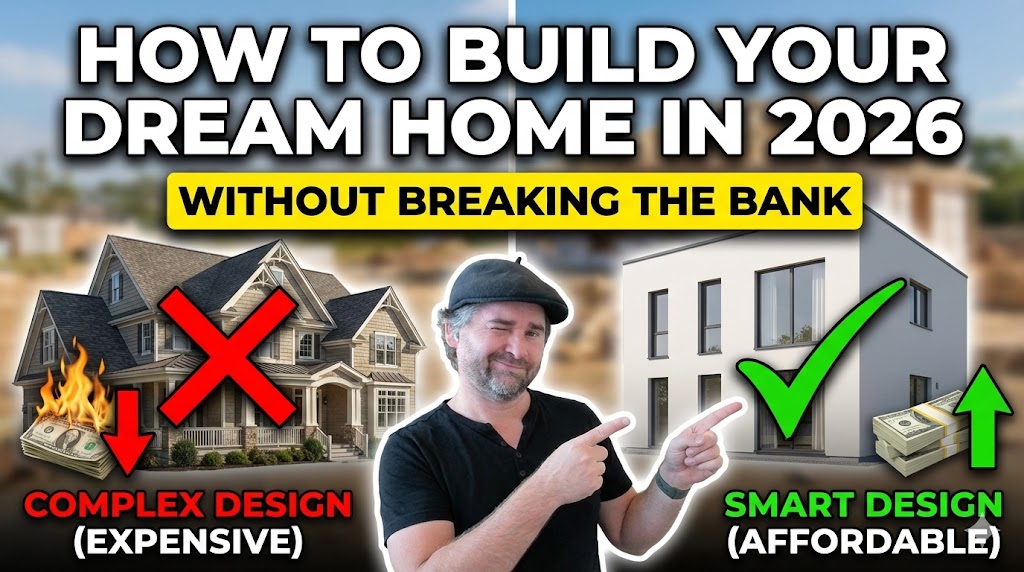
HOW TO BUILD YOUR DREAM HOME IN 2026
Without Breaking the Bank
A homeowner meticulously planned a $2.5 million build, their family eagerly dreaming of their perfect future. Even after the architect warned it was stretching their budget, they kept adding more scope, each room a promise to their children, each detail a step closer to the dream.
After spending $300,000 on full documentation, including landscaping, reality hit brutally: the builder priced their vision at $9 million.
The emotional fallout was devastating. Relationships strained, arguments erupted and hopes crumbled under the pressure. Their "dream home" became a $300,000 pipe dream.
They’re not alone.
Once lodged, project approvals in Western Australia hover around 84%. Yet the real danger zone occurs much earlier, at the dream stage.
Money is the big leak. In FY24–25, only about 41% of homeloan pre-approvals converted to settlement. That isn’t just banks declining loans, it's families forced to abandon dreams they've emotionally and financially invested in.
And here’s the hidden truth: in our experience, from "starting the dream" to "starting the build," around 80% drop out. That's 4 in 5 households whose dreams stall, change, or shatter, usually after that first serious quote.
This article exists to stop you funding a fantasy. It will show you exactly how to confirm feasibility early, before your dream becomes another heartbreaking statistic.

Choose How You Want to Learn:
Flexibility for different learning styles — all blocks optional, use one or all, you choose.
🎧 Listen on the Go:
Audio version for your commute
☕ Coffee Chat with Your Passivhaus HUB Mentors:
Join senior trainers Julia and Daniel as they share insider tips you won't find in textbooks. Real talk about what actually works on-site.
Part 1 audio:
Part 2 audio:
🎙️ Hear It From Aime & Aiden
Our AI podcast hosts break this down into bite-sized insights. Perfect for your morning walk.
🎶Playlist of the day!
1 The Biological Blueprint: Why Home Isn't Optional
But this isn't just the story of a dream home that never materialized, it's biology being neglected. Every mammal instinctively builds or seeks out a nest, burrow, or den. For humans, this instinct runs even deeper because our offspring depend on us longer than any other species. A home isn't optional; it's essential. It provides physical safety from harsh weather, extreme temperatures, noise, and intruders and safeguards health through clean air and a mould-free environment. Crucially, a stable home ensures psychological wellbeing, offering a secure base to raise children and recharge ourselves. This profound biological drive explains why renting can often feel inadequate, and owning a home is deeply satisfying. Recognizing this innate human need isn't just emotional; it's the critical first step toward smarter, practical decisions about building the home that truly supports the life you desire.
So, if having a home is fundamental to our nature, how did it transform into the daunting financial burden it is today?
2 Social Proof: Why Status Beats Sense in Building Choices
To understand how homes transformed into such overwhelming financial burdens, we must first understand human culture, specifically, our innate instinct to compare ourselves to others. We've all seen it: when one neighbour buys a shiny new car, it's not long before the next neighbour follows suit, often with something slightly better, larger, or flashier. This pattern isn't limited to cars, it applies to homes as well. Solar panels have spread rapidly precisely because they're visible, a clear badge proclaiming, "Hey, look at me, I'm environmentally responsible!" Meanwhile, genuinely sustainable homes like Passivhaus remain relatively hidden because their benefits, quiet comfort, efficiency, and resilience, occur largely behind the scenes, invisible to passersby.
This craving for visible status leads us directly into the hands of volume builders and their marketing campaigns. We're convinced we must have that front room, the theater room, or the parents' retreat, not because we genuinely need them, but because we're told that without these spaces, our homes won't hold their value or be easily resealable. We begin seeing our homes primarily as financial assets rather than essential sanctuaries. These deeply human instincts push us toward dreams that inevitably burst, explaining why four out of five home building journeys collapse before construction ever begins.
3 Forced into Corners: How Regulations Sabotage Smart Homes
But it isn't just human behaviour working against us; external forces beyond our control significantly shape our home building choices. Imagine this: you've meticulously designed your perfect home, every detail carefully considered, exactly as you've envisioned. And then, just as excitement peaks, the government steps in and tells you it's not allowed due to restrictive R-codes. At the same time, your bank refuses financing, labeling your thoughtfully designed home as "out of the norm" or "undervalued."
Building regulations, combined with lot shapes, often compel you into creating homes that are costly, inefficient, and unnecessarily complicated. R-codes paired with narrow, elongated lots transform straightforward plans into awkward jigsaw puzzles filled with excessive external corners, each one increasing the home's cost, complexity, and risk of issues like leaks or poor insulation.
These two external pressures, the rigidity of regulations and an inflexible financial system, aren’t just inconveniences; they're major emotional and practical roadblocks. Recognizing and strategically addressing these challenges is essential if we’re to reclaim control and truly build the homes we dream of.
4 Priced Out: How Today's Housing Market Compares to the Past
Let’s step back into reality for a moment. Does it genuinely feel harder to afford a home today compared to 10, 20, or 30 years ago? Or is my generation simply less willing to work for it? Let's examine the facts, and my family’s story.
My grandparents were humble workers in an aluminium factory, supplementing their modest income by farming chickens and rabbits right in town. Yet, they comfortably built a spacious three-storey home, complete with a rental apartment and a large workshop where my grandfather crafted and sold willow baskets.
My parents took the next step: my father went to university, and my mother pursued higher education in holistic medicine. They were able to afford an old farmhouse, gradually renovating it over more than a decade, a meaningful and manageable financial commitment.
And now there's me. Even with two engineering master's degrees and years spent travelling globally to build a strong career, I'm still renting an apartment, paying $1000 a month, and struggling to buy even a modest home. To be honest, it's deeply frustrating and disheartening. Have I just been lazy, or are the numbers genuinely stacked against me?
Here’s the truth in hard numbers: In 1985, the median house price to income ratio was just 3.4. By 2025, it surged dramatically to 12.2. In simpler terms, a home that took only 3.4 years of income back then now takes 12.2 years. And it’s worse when you consider that today's households typically have multiple earners, meaning the affordability gap is even larger for single-income earners.
When we compare Australia's housing valuations globally, to countries like the UK, Canada, or the US, our market clearly stands out as significantly overvalued. This isn't sustainable, and a market correction is inevitable.
If you're still treating property purely as a financial investment, hoping for perpetual price increases, the news isn't good: this gravy train is approaching its final stop. But if your goal is genuinely building your dream home, a home designed specifically for the life you want, you don't have to care what the market does next. Whether its value rises or falls, it's your home, your sanctuary, your life.
It's time to stop building solely for profit and start building for living.

5 The Full Battle Plan: Escaping the Financial Housing Trap
So, how can you and I escape this affordability trap? How can we build our dream home today, without breaking the bank and without gambling on endlessly rising property prices?
5.1 Breaking the Myth: Why Two Stories Save You Money
Let’s stop one of the biggest myths in the building industry.
FACT: Two-story homes are cheaper than single-story homes.
It genuinely makes me furious that some professionals still claim otherwise, because the math is so straightforward.
Imagine taking a simple single-story layout and stacking half of it vertically. Instantly, you've eliminated 50% of your expensive slab and roof, completely removed, not just reduced.
Less slab and roof means fewer materials, lower costs, and dramatically reduced energy loss. With less external surface, your walls and insulation can achieve the same thermal efficiency more simply and economically. Yes, you’ll need stairs and an additional floor structure, but these are minimal expenses, often replacing costly, inefficient hallways.
The biggest saving, however, comes from land. Building vertically means a smaller, cheaper lot and significantly lower land costs.
Simply put, two-story homes clearly save money, perform better, and use land efficiently. Don’t accept outdated industry myths, trust the simple arithmetic.

5.2 Site Selection: Your Hidden Savings Opportunity
Now that you know you need less land than originally thought, you've already saved money. But be careful, site selection can either dramatically reduce or inflate your overall building costs.
FACT: Choosing the right site saves you significant money, but only if you involve the right expert early.
One of my former clients, and now a friend, wanted to buy a beautiful hillside site in Perth. The developer confidently stated the site access would cost around $80,000. But something didn't add up for me, I didn't trust that $80,000 quote. My experience told me it would be significantly higher. We requested actual pricing from contractors, and sure enough, the real cost came back at $150,000. Suddenly, the site became unaffordable, and my friend wisely stepped away from the purchase.
This real-life example shows exactly why your trusted builder should be involved from the start. Builders understand the realities on the ground and can accurately foresee hidden complications designers might overlook, including:
• Soil Quality: Different soils dramatically affect foundation costs.
• Site Access and Services: Connecting essential utilities can rapidly escalate expenses.
• Hidden Costs and Fees: Experienced builders anticipate unforeseen expenses that could derail your budget.
Also, pay attention to site orientation and shape. Narrow blocks severely restrict design options, creating inefficient layouts and higher construction costs.
Here's a practical tip:
If your building regulations limit you to around 50% site coverage, choose a site roughly twice as deep as it is wide. This allows a compact, square home with a practical backyard, comfortably meeting regulatory setbacks. Even a depth-to-width ratio of 1.5:1 can still be efficient.
Most importantly, choose your experts carefully. Your builder should ideally have Passivhaus training and practical experience, collaborating closely with a knowledgeable Passivhaus Designer. Working together from the outset isn't just about achieving quality, it significantly reduces costs.
Remember, your builder isn't merely executing designs; they're safeguarding your budget, protecting your dreams, and helping you avoid costly mistakes.
5.3 Eliminate Outdated Services: Electrify Your Future
It's time to remove outdated services from your home, starting with gas.
Some still prefer gas, but consider the reality carefully: electricity, particularly solar-powered, is cleaner, safer, and undeniably the energy of the future. Gas cookers may offer quick heat, but modern induction cooking is equally fast, more precise, and significantly safer.
Ask yourself honestly:
• Do you really want a device in your home competing with you for oxygen?
• Do you really want equipment in your home that, if misused, could turn your house into a potential hazard?
• Do you really want appliances creating harmful gases that can impact your family’s health?
If you're unsure, I highly recommend experiencing induction cooking firsthand. Brands like Bora showcase exceptional induction cooktops and innovative downdraft extraction systems that outperform noisy, bulky range hoods.
Fully electrifying your home is not just smarter, it's essential for creating a safer, healthier, and more sustainable future.
5.4 Smart Construction Choices: Move Beyond Double Brick
It's time to leave outdated construction methods behind, starting with double brick.
Did you know the ancient Romans used double brick construction paired with single glazing? Surely, we've advanced beyond technology from 2,000 years ago. Almost all other modern building methods are acceptable, if executed correctly, but double brick construction no longer makes sense.
If sustainability matters to you, also reconsider metal framing and keep concrete usage minimal. Both are resource-intensive materials with significant environmental footprints.
If you have a little bit of money to spend and value quality, then check out CLT (Cross,Laminated Timber).* The initial investment seems to be higher, but CLT has significant benefits, like cutting your construction time often to half or even more. The pre-planning and precise design, combined with the robustness of the material itself, provide solid brick-like surfaces, while significantly reducing the risk of mistakes and compromising airtightness, nearly to zero, as your airtightness layer is placed externally of the CLT panel. Actual thermal comfort often exceeds theoretical calculations, especially regarding protection against summer overheating. When all additional costs are properly compared to the reductions in risks and substantial time savings, CLT construction can ultimately match or even beat the cost of traditional methods over time.
Think about the true cost of your build, not just materials and labour but also carrying costs. Would you rather pay construction-related expenses and continue renting for two years, or move into your completed home within six months? Faster construction methods like CLT, Structural Insulated Panels (SIPs), and well-executed timber framing make this achievable, greatly reducing costs associated with prolonged build times.
Stay informed and open to innovative building methods and prefabrication solutions available now and in the future. Make smarter construction choices that save time, money, and the environment, while delivering the comfort you deserve.
*Full disclosure: I'm personally involved with supplying CLT because I've experienced its benefits firsthand.

5.5 Size Matters, But Bigger Isn't Always Better
Did you know Australia builds the biggest houses in the world?
• Average Australian new home: 235.8 m² (2019/20, CommSec), even larger than the US at 233.1 m².
• European average dwelling size: approximately 103 m² (Eurostat).
Let's look closely at this difference.

This means the additional 203 m² add only 1 extra bedroom, 1 extra bathroom, 1 additional toilet, and 1 leisure area.
Now, consider the full reality of adding these extra spaces:
• Construction Costs: An extra 203 m² means spending an additional $500,000 to $1.5 million.
• Operational Costs: Higher energy bills for heating and cooling, increased cleaning time, greater maintenance, and repair costs.
• Points of Failure: Every additional square metre introduces more areas prone to leaks, insulation issues, drafts, and general wearandtear, increasing maintenance burdens and long-term costs.
• Emotional Costs: Consider the hustle, stress, and financial pressure needed to earn and justify this substantial extra investment.
Ask yourself honestly:
• Is the extra bedroom, bathroom, toilet, and leisure room really delivering enough value for your family's lifestyle?
We can, and should, do far better.
Spend more time in thoughtful planning and design. Yes, your cost per square metre might increase slightly, but your overall expenses will significantly decrease in construction, energy bills, and ongoing maintenance.
Think carefully about what you genuinely need, not what brokers or sales agents insist you should have. Evaluate every aspect of your home on a scale of 1 to 10, where 10 is essential and 1 is unnecessary, and include only items scoring above 7. You'll quickly realize that your home can become much more affordable and practical.
Finally, build flexibility into your design. Consider creating a layout that allows easy future expansion, like when unexpected triplets arrive. If you're already building extra rooms, consider designing that portion of the home to be temporarily rentable as an apartment or Airbnb until you genuinely need the additional space.
In short:
Smaller, thoughtfully planned homes reduce stress, lower costs, and provide greater adaptability for your future.
6 Before You Design Anything: Get the Priorities Right
I still remember it clearly.
I was getting out of my car when I saw my neighbour standing outside his house, his skin covered in severe eczema, raw, flaky, and visibly breaking apart. Just weeks earlier, I'd seen him full of energy, fit, healthy, athletic.
Concerned, I asked, “What happened?”
He spoke of water leakage. Then mould appeared, first a little, then everywhere. Since this is my specialty, I asked to have a look inside. What I saw was shocking. Every surface was mould-infested. The smell was overwhelming, and I even encountered mould species I'd never seen- purple, aggressive, alive.
Standing beside me, he struggled to breathe, coughing through asthma attacks. His home had become a severe health hazard. The only honest advice I could give was simple but critical:
“You need to get out of here. Immediately.”
At this point, it wasn’t about aesthetics.
It wasn’t about stylish finishes.
It wasn't even about money.
It was about health.
Building your home is likely the largest one-off investment you'll ever make. Yet, how much do you genuinely know about how homes function?
Think about it. Can you confidently answer these questions?
• How many kilowatthours do your heating, cooling, fridge, or cooktop use?
• What's the thermal performance of your walls, roof, and windows?
Chances are, you, like most people, don't know these details.
But if I asked about your car, you'd likely have answers:
• What type of petrol it needs
• Engine size
• How many litters needed for 100 kilometres
• Whether it has airbags, electric windows, or steering assistance
• If it's manual or automatic
Isn't it strange we often know more about our cars, much smaller investments, than we do about our homes? Our emotional connection and detailed knowledge of vehicles seem disproportionately higher.
You must shift this mindset. Nobody has a greater vested interest in your home's success than you. Even passionate professionals must balance quality against time and economics, inevitably leading to compromises.
Empower yourself. Use the resources on our website, many are free, and leverage artificial intelligence to learn, understand, and evaluate your design choices.
Sure, that marble benchtop feels sexier than insulation hidden inside your walls. A handcrafted bathtub looks far more impressive than ventilation outlets, and a golden toilet gets more attention than hidden airtightness membranes. However, it's your insulation, ventilation, and airtightness systems that significantly shape your daily quality of life, comfort, health, and safety, and these can't be easily or affordably changed later.
Kitchens, bathrooms, and flooring can be updated easily, whether five, ten, or fifteen years down the track. But adding insulation later? Barely feasible and prohibitively costly. Improving airtightness after construction? A total nightmare.
Imagine moving in, only to discover within a year or two that your home is uncomfortable, energy bills are skyrocketing, or worse, you've developed mould and symptoms of sick building syndrome. At that point, you'd gladly trade your $50,000 designer kitchen for a basic $5,000 IKEA kitchen if it meant restoring comfort and protecting your family's health.
Here's what must be correct from day one, non-negotiable, zero compromises:
1. The Building Envelope
2. Heat Recovery Ventilation System
These critical elements can only be effectively installed during initial construction. Fixing them afterward is extremely expensive, disruptive, and often impossible.
Once you have these fundamentals right, your next priorities should be:
• Efficient air conditioning systems
• Solar power generation
• Domestic hot water efficiency
• Energy-efficient refrigeration
• Home battery storage
Appliances like cooktops, ovens, microwaves, and lighting are easy to replace later.
Before spending money on new appliances, first consider integrating charging capabilities for your electric vehicle and installing a backup system for your home. These affect your home's infrastructure and wiring and are far easier, and cheaper, to address during construction.
And don’t rush to replace your furniture. Older furniture is often healthier because it has already completed its off-gassing phase. Replacing everything at once isn't economical or sustainable. Keep what you have and upgrade gradually, piece by piece, when your budget allows.
But perhaps I'm getting ahead of myself. My primary role isn't helping you choose finishes or appliances, those are enjoyable details you can decide later. My responsibility is ensuring your dream home remains exactly that, a healthy, comfortable, high-performing sanctuary.
With your priorities now crystal clear, let's start designing.
7 Define Phase: Designing with Clarity and Efficiency
By now, you should clearly understand what you truly need, before even starting the design.
We've established some foundational principles already: build smaller, compact, and two-storey rather than single-storey. Now, let's define clear design rules to guide your journey.
7.1 Minimize Complexity: Limit External Corners
Keep your home's external corners to a minimum, ideally just four corners, with all four sides equal in length. This configuration provides the smallest possible external wall area relative to your usable internal space, drastically reducing construction complexity, initial building costs, long-term maintenance expenses, and potential points of failure.
Over Christmas, I visited a friend's house and counted 16 external corners and 84 internal corners. It was single-storey, of course, and practically impossible to place furniture efficiently, even placing a simple cabinet was difficult. Consider the complexity, the challenges of constructing such intricate rooflines, and the countless potential points of failure this introduces. The unnecessary cost and stress this adds are significant.
European homes often appear as simple boxes, not due to a lack of design creativity, but precisely because European designers understand clearly what drives construction costs and long-term maintenance issues. Simplicity isn't a design failure, it's smart economics.
7.2 Good Design Isn't About Shapes, but Surfaces
People often say: “I don’t want my house to look like a box.”
Here's my answer to this common objection:
All great art is created within limitations.
• A painter starts with a rectangular canvas.
• A musician composes within a limited scale.
• A sculptor carves from a single block of stone.
Picasso didn’t become famous by adding unnecessary complexity.
Mondrian achieved iconic status using only straight lines and three primary colours.
Japanese masters create beauty by removing noise, not by adding decoration.
Limitations are not the enemy, they are the very thing that ensures quality.
Buildings are exactly the same.
When you restrict the shape, keeping it compact, simple, clean, you ensure the quality must come from:
• Proportions
• Materials
• Light
• Surfaces
• Textures
• Detailing
Not by slicing the building into ten awkward shapes.
A simple building form never creates ugliness, poor design does.
A thoughtfully designed 'box', carefully proportioned, beautifully detailed, and constructed with quality materials, will always look and feel superior to a complicated home built cheaply.
A skilled designer knows exactly how to avoid the "boxy" look by creatively working with surfaces rather than shapes. Multiple finishes, thoughtful colour schemes, and tasteful artwork effortlessly eliminate any perception of plainness.
Additionally, smart use of attached features like garages, balconies, terraces, and garden sheds further break visual monotony, adding character without unnecessary complexity.
7.3 Avoid Unnecessary Complexity in Setbacks
Instead of implementing setbacks that constantly change or stepping back the upper level to create visual interest, position the entire building consistently. Irregular setbacks and unnecessary structural "jumps" don't add real value, they only increase complexity, initial construction costs, ongoing maintenance costs, and potential points of failure.
In short, embrace simplicity in shape, focus creativity on surfaces, and avoid unnecessary complexity. This approach saves significant amounts of money, reduces ongoing expenses, minimizes risk, and enhances comfort, ultimately protecting your investment long-term.
8 Building Physics: Safeguarding Your Home Investment
Imagine investing hundreds of thousands of dollars, years of planning, and endless dreams into your perfect home, only to discover it's uncomfortable, costly to heat or cool, or even worse, damaged by moisture. Your dream home is now a financial nightmare. How could you have avoided this?
Simple answer: Understand the science that makes a home truly work. Building physics isn't abstract, it's essential. Let’s break it down clearly, so you never end up with a dream turned into a disaster.
8.1 Passivhaus Fundamentals: Protecting Your Comfort and Investment
Passivhaus isn’t just a buzzword; it's your best insurance policy. Developed rigorously in Germany, the Passivhaus standard is the gold standard for comfort, efficiency, durability, and resale value.
It relies on five proven fundamentals:
• Thermal Insulation: Continuous, effective insulation ensures minimal heat transfer, keeping you comfortable in every season.
• Airtightness (≤0.6 ACH50 at 50 Pa):
This is the Passivhaus airtightness target, verified with a blower door test.
Less leakage means fewer drafts, lower bills, and far lower moisture risk.
Airtightness isn’t optional; it’s foundational.
• High-Performance Windows: Double or triple glazing with quality frames prevent heat loss and moisture problems while boosting comfort dramatically. More to this in the next chapter.
• Thermal Bridge-Free Detailing:
Thermal bridges create cold spots, and cold spots rapidly become mould spots. Eliminating thermal bridges isn't merely about preventing energy loss; it's fundamentally about protecting your family's health. Mould growth caused by these cold spots directly affects indoor air quality and can lead to respiratory problems, allergies, and other serious health issues. Thermal bridge-free detailing ensures your home remains safe, healthy, and structurally sound over the long term.
• Heat Recovery Ventilation (HRV):
Fresh air flows in, stale air moves out, without losing your carefully controlled indoor climate. HRV systems precisely deliver fresh, clean air exactly where and when you need it, removing moisture and odours from bathrooms or kitchens while supplying comfortable, filtered air to bedrooms and living spaces. All this occurs without significant additional heating or cooling demands, effortlessly maintaining your home's perfect temperature balance.
Running costs can be low: fan electricity is often under $100 per year. Filters and servicing are additional, but still minor compared to the health benefits.
When these fundamentals come together, your investment is protected, your home feels comfortable, and your energy bills plummet.
Bonus: Recent data from Domain’s Sustainability in Property Report 2025 shows that energy-efficient homes are selling for a measurable price premium, roughly $118,000 more than equivalent standard homes nationally, a ~14.5 % value uplift on average. The market clearly rewards better performance and lower running costs. While energy efficiency is already adding significant resale value, a Passivhaus, widely recognised as the highest standard in energy-efficient design, can be expected to outperform this benchmark in both comfort and long-term financial return.
8.2 Quality Assurance During Construction: Don't Build Blind
Would you drive a new car without checking if the brakes work? Yet many build homes without verifying airtightness or ventilation, risking both comfort and investment.
Passivhaus demands verifiable quality checks during construction, including:
• Mid-construction Blower Door Test: Ensures airtightness before walls are closed, catching costly mistakes early (not mandatory).
• Final Airtightness Test (≤0.6 ACH50): Guarantees the standard is met, securing long-term performance and comfort.
• Ventilation Commissioning: Balanced, calibrated ventilation is non-negotiable, directly protecting indoor air quality, moisture control, and efficiency.
• Photo and Documentation Checkpoints: Clear evidence of insulation placement, airtightness sealing, and ventilation installations safeguard quality standards.
Quality assurance isn't optional, it's essential protection for your home, likely the biggest single investment of your life.
8.3 Moisture and Condensation Management: Your Invisible Enemy
Passivhaus dramatically reduces moisture risks by enforcing airtightness (≤0.6 ACH50), balanced ventilation (HRV), and thermal-bridge-free design. Yet it’s critical to understand a key limitation: Passivhaus standards do not explicitly regulate moisture movement within building assemblies. This means a home can meet Passivhaus criteria yet still be vulnerable to hidden condensation and moisture problems if not properly analysed.
Unfortunately, half-knowledge and assumptions about moisture risk are common. Relying solely on airtightness and thermal bridgefree detailing is insufficient. Insist on detailed hygrothermal (moisture) analysis using specialist simulation software like WUFI. WUFI models how moisture moves through walls, roofs, and junctions over time, helping you avoid condensation traps that lead to mould, decay, and structural issues.
Moisture damage isn’t just a technical headache, it affects indoor air quality, health, and long-term durability. Don’t assume your builder or designer automatically covers this. Professional moisture analysis isn’t a luxury, it’s essential risk management for your home, your family’s wellbeing, and your financial protection.
Know now, so you don’t regret later.
8.4 The Real Cost of Passivhaus: Investing Wisely
Here's the critical financial insight:
The additional investment to build a Passivhaus typically amounts to less than $500 per square metre compared to a conventional build. Especially if you're following the advice in this Dream Home Guide. However, if your baseline is already aiming for a quality home with good insulation and airtightness, the cost difference can be significantly lower.
Since detailed energy modelling (PHPP) is already integral to smart design, you now have the power to make fully informed choices. You’ll see exactly how your building performs under different scenarios, enabling educated decisions on whether to meet, exceed, or slightly relax the Passivhaus standard. Working closely with your team of Passivhaus experts, you’ll understand each metric, each design option, and their real-world impact.
Perhaps you’re comfortable with an indoor temperature range of 19–26°C rather than the Passivhaus standard of 20–25°C. This slightly wider range might not fully achieve certification, but it’s your personal preference, your comfort.
The point is, now you decide with clarity. Your home, your standards. No more guessing, only confident, informed choices.
Passivhaus isn't a luxury, it's an intelligent financial strategy. Your upfront investment pays dividends not only in ongoing energy savings but directly through higher market value.
9 Your Home, Your Future -Secured
When you grasp these building science essentials, you're not just building a house, you're safeguarding your dreams, your finances, and your family's long-term health. You're creating an asset that outperforms the market, slashes your monthly expenses, and ensures comfort year-round.
Building physics isn't optional, it's your strongest protection.
Perhaps investing in a Passivhaus Designer or Trades course yourself isn't such a crazy idea after all. Compared to the risks you'll avoid, it's a small investment with massive returns. Nobody has a greater stake in your home's success than you. Don't leave critical decisions about building physics to chance or blindly trust others with your family's future.
Do it right once, and your home will reward you every single day.
10 Windows: The Secret to Cost-Effective Quality
I remember vividly one of my first clients in Perth. They had a window installed, a fixed piece, elegantly positioned over their staircase, spanning 3 metres long by 1.5 metres high. On paper, it was just another rectangle. But once the build was complete, something magical happened.
Everyone who stepped into their home paused at this window, captivated. It wasn't simply glass, it became a living painting, framing Perth’s vibrant skyline. Conversations naturally gathered there. Each day, the window offered a new version of the city, sometimes glowing, sometimes misty, always mesmerising.
You see, windows aren't merely functional openings. They're the jewellery of your home, visible to everyone who passes by. Like exquisite furniture or striking artwork, they express your personal style, enrich your daily experience, and significantly impact your wellbeing.
Windows blend the essential and the emotional: crucial for thermal comfort, energy efficiency, and airtightness, yet, unlike hidden insulation, they proudly display their beauty. They’re where your home's practical performance and personal expression meet.
But windows also come with a price tag, often substantial, making them a financial focal point of your project. Sadly, misinformation is widespread, and clear guidance from national standards is scarce, making wise window choices challenging.
First, let’s gain clarity on the windows you genuinely need, and why they deserve careful consideration. Then, we'll ensure they’re not only beautiful but cost-effective too.
Quick Note on Transparency and Windows:
For complete transparency, I've started Smart Plus Windows, specializing in importing high-quality European triple-glazed uPVC windows. Like the decision to offer CLT, this choice is driven by a clear commitment to providing the best available solution for WA homes.
Yes, triple glazing might traditionally seem like overkill in our market. However, the price difference between double and triple glazing from our European suppliers is minimal. We're therefore able to offer you premium triple glazing at prices you'd typically expect to pay for high-end double glazing, starting from approximately $1,200 per square meter, inclusive of sliding and French doors.
Certainly, lowercost alternatives exist and often cost around half our rates. But the difference in aesthetics, durability, comfort, and overall performance is dramatic. Given that the cost of window installation alone commonly reaches $50,000 or more, investing in cheaper windows is like paying your mechanic more for fitting your tyres than the tyres themselves cost. Simply put, it doesn’t make financial or practical sense.
We chose quality first, because your home deserves better.
10.1 Window Types and What to Use
Every window is a partnership, frames and glazing, working hand-in-hand. Understanding both is essential for making the best choice for your home. Let's first dive into the heart of windows: the glazing.
10.1.1 Glazing: Invisible Performance You Can't Ignore
Your glazing must be meticulously tailored to your home's specific needs. Factors like location, orientation, and the amount of glazing all directly impact your comfort, energy costs, and even your home's longevity.
This isn't guesswork, it's science. National standards fall short; they're political compromises, not physically accurate tools. Real clarity comes only from modelling your glazing using a reliable method, such as the Passivhaus Planning Package (PHPP).
Here’s what you absolutely must know:
• Double Glazing (Minimum): Single glazing isn't even on the table, it belongs in history. Double glazing is your baseline for comfort and efficiency.
• Warm-Edge Spacers (Essential): Don't make the common mistake of settling for aluminium spacers. They're energy leaks in disguise, like wearing a premium down jacket in freezing temperatures but leaving your hands bare. Warm-edge spacers, like those from Swisspacer, dramatically reduce heat transfer. Skimping here can easily cost you an extra $1–2 per linear metre annually. In an average home with around 100 linear metres of spacers, that's up to $200 wasted, every year, forever.
• U-Value (Lower is Always Better): A lower U-value means less heat loss and more savings. Always aim for the lowest practical U-value your budget allows.
• G-Value (Critical to Comfort): The g-value measures how much solar heat your glazing allows inside. Get this wrong and it’s costly: too high in hot climates, your home overheats; too low in cold climates, you miss valuable warmth, both mistakes mean spending more money every year. Even a miscalculation can cost up to $10 per m² of glazing annually. With just 50m² of glazing, that's an extra $500 every single year.
NOTE: G-Value similar to SHGC (Solar Heat Gain Coefficient), but SHGC includes the frame, making it unsuitable for precisely optimising your glazing choices.
This isn't pocket change, it's thousands over a lifetime. Mistakes here compound quickly.
These choices aren't trivial. They're complex decisions best navigated with the guidance of a Passivhaus Designer who can accurately model your project using PHPP. Windows are long-term investments, make the right choices upfront, and you'll reap benefits in comfort, efficiency, and cost savings for decades.
Once the glazing is right, the frame becomes decisive, because even the best glass fails in the wrong frame material.
10.1.2 Frame Your View, Frame Your Life: Choosing the Perfect Window Frame
Window frames aren’t just technical necessities, they are integral parts of your home's aesthetic language. Like the frame around a masterpiece or the setting of fine jewellery, your window frames elevate your home's visual impact. Choosing wisely is vital.
There are three common frame materials in Australia:
• Aluminium - thermal conductivity (λ): ~205 W/m·K
• Timber (wood) - thermal conductivity (λ): ~0.14 W/m·K
• uPVC (vinyl) - thermal conductivity (λ): ~0.17 W/m·K
o Thermal conductivity is only one piece. Window performance is captured by U-values (Uw and Uf).
• In plain terms: aluminium conducts heat roughly 1,200–1,500× faster than timber or uPVC. That’s why basic aluminium frames feel cold and can drive condensation risk.
Thermally broken aluminium systems do exist, but genuine high-performance options are extremely expensive. Unfortunately, most products labelled "thermally broken" in our local market are simply broken, not thermally efficient, and should never be seriously considered.
Be vigilant: the marketing typically promotes the overall "window U-value," mixing a high-quality glass unit with a poorperforming aluminium frame. This combination produces misleading results. Instead, always insist on seeing the pure frame U-value (Uf) alone, this critical detail often gets conveniently overlooked. If suppliers avoid providing this figure, take it as a red flag. True performance transparency means understanding exactly how the frame itself performs, not just the glazing.
But uPVC window frames are not manufactured as solid blocks. Instead, uPVC frames have carefully engineered internal air chambers. These chambers dramatically lower the effective thermal conductivity, and can pushing the practical lambda (λ) value well below 0.1 W/m·K. As a result, real-world uPVC frames significantly outperform timber windows in thermal insulation. They’re also more durable, require less maintenance, and provide better long-term value.
Some fear uPVC won’t survive Australia’s UV. Quality uPVC uses UV stabilisers and is proven in harsh climates. Check warranties and be cautious with very dark colours.
Timber frames benefit significantly from alucladding, gaining durable, maintenance-free protection against the elements. For uPVC frames, alu-clad isn't essential for weather protection, since uPVC is already highly durable. However, alucladding expands your color choices significantly. If you desire a specific color or finish not typically available with standard uPVC, alucladding gives you that flexibility and aesthetic freedom.
In short: alu-clad for timber delivers essential protection and colors, while alu-clad for uPVC primarily offers aesthetic freedom and design flexibility.
For cost-effectiveness, white uPVC is hard to beat. If white isn’t your style, modern uPVC offers many finishes.
Your window frames are more than structure. They’re your home’s jewellery, and they shape comfort for decades.
10.2 Fewer Windows, Bigger Impact
The secret to cost-effective, beautiful windows? Fewer windows, each generously sized.
Windows are among the most expensive elements of your building envelope per square metre, significantly pricier than walls. But here's the twist: the glazing isn't the primary culprit, the frame is. Frames are essential but costly, a necessary evil that eats your budget while offering limited visual or performance value.
The solution? Go big.
Larger windows drastically reduce your frame-to-glazing ratio. Less frame, more glass= more savings and an expansive, uninterrupted view.
Here’s a practical strategy: transform your doors into windows. If you have a terrace or balcony, skip the half-height windows and go for full-height windows that function as doors. You eliminate redundant framing and reduce complexity, saving money while enhancing functionality and beauty.
10.1 Ideal Window Dimensions
To achieve the best performance and practicality, consider these ideal dimensions:
• Openable Windows:
o Ideal size: 2.1 m high by up to 1.2 m wide
o Wider than 1.5 m? Usually impractical, unless tiltonly, due to room intrusion when opening inward.
• Fixed Windows (non-openable):
o Double glazing: Up to 4 m² (approx. 120 kg per panel)
o Triple glazing: Up to 3 m² (approx. 180 kg per panel)
Be mindful of transportation and installation constraints: generally, windows shouldn't exceed 2.3 m in height due to logistical challenges.
Single glazing? Not an option. It's outdated, inefficient, and will cost you dearly in comfort and energy bills. Always choose double or triple glazing.
Quick Reference Summary:
• Fewer, larger windows = lower frame-to-glass ratio.
• Frame costs more than glazing, reduce frame to save money.
• Full-height glazed doors double as efficient windows.
• Openable window ideal size: 2.1 m (H) × 1.2 m (W) (max practical width: 1.5 m).
• Fixed windows (double glazing): up to 4 m²; (triple glazing): up to 3 m².
• Avoid heights beyond 2.3 m due to transportation limits.
• Always opt for double or triple glazing; avoid single glazing at all costs.
11 Accurate Modelling or 300% Errors: Guesswork You Can’t Afford
As already mentioned, every high-performance home must be modelled using PHPP or an equivalent physics-based tool.
National standard modelling is not sufficient. It is a political instrument, not a physical one, and it routinely allows errors of 150–300% compared to real-world performance. That level of inaccuracy is unacceptable if you want to optimise your home economically and thermally.
I know this from direct research experience. While working in Germany as a researcher on the EU-funded INTERREG – TEM3, B20 project (Improvement of Knowledge Transfer in Sustainable Building), we compared measured building performance with calculated results using:
• National standards (Germany, Switzerland, France)
• PHPP
The results were confronting.
National standard models deviated from reality by 150–350%.
PHPP, by contrast, stayed within 25%, and even that remaining gap was almost entirely explained by user behaviour and air leakage in existing buildings.
This reveals a critical truth:
The more airtight a building is, the more accurate the model becomes.
When a building is constructed airtight, like a Passivhaus, the predictive accuracy of PHPP exceeds 95%, excluding occupant behaviour. As air leakage increases, modelling accuracy collapses.
This is why PHPP isn’t optional.
If you want to:
• choose the right glazing,
• verify whether your design decisions actually work,
• and avoid wasting money on ineffective measures,
then modelling in PHPP (or equivalent) is the only rational path.
11.1 Your Secret Weapon: The Digital Twin
PHPP allows you to create a digital twin of your home before construction begins.
This digital twin makes performance visible and measurable. It allows you to accurately determine:
• exactly how much insulation you need (no more, no less),
• which window types and sizes actually work,
• where shading is required to prevent overheating.
This isn’t theory. It’s proven practice that saves real money and delivers real comfort.
By modelling first, problems are solved on paper, not on site. And solving problems during planning is always dramatically cheaper than fixing them during construction.
11.2 Financing Smartly: Make the Numbers Work for You
Accurate performance modelling doesn’t just protect your build budget; it also unlocks smarter financing.
High-performance homes increasingly qualify for green home loans, typically offering lower interest rates. Even modest rate reductions can translate into tens of thousands of dollars in savings over the mortgage lifespan. But be careful: just because a loan has the "green" label doesn't automatically make it the best deal. Always check the fine print and carefully compare terms. Sometimes conventional loans without a green label can offer more favourable conditions overall.
In short:
PHPP helps you design better, build smarter, and pay less, both upfront and long-term.
If you care about performance, comfort, and money, this step is non-negotiable.
12 What's Not Covered (And Why)
This guide is your foundation for building a high-quality, cost-effective home, but it doesn't include every tool you'll need along the way. Some topics require specialised detail beyond the scope of this article. Here’s what we didn't cover, but strongly recommend you explore further:
12.1 Feasibility Gates
A systematic approach to confirm financial and design viability before committing significant funds. Establishing feasibility gates, clear "stop/go" checkpoints, helps ensure your dream stays achievable at every step, avoiding costly redesigns or disappointment.
12.2 Budget Protection Tools
Strategies such as contingency budgeting, escalation allowances, and managing provisional sums are crucial for safeguarding your finances. These protect your project from unforeseen market shifts or scope creep during the construction phase.
12.3 Procurement and Contracts
Choosing the right method to deliver your project, Design and Construct, Architect-led Tender, or Cost-Plus, has substantial implications for your budget, timeline, and risk exposure. Understanding the pros, cons, and best practices of each method ensures your investment is protected.
In summary: To fully secure your project's success, complement this article with careful feasibility planning, robust budget protection strategies, and informed procurement choices. These are specialised but essential topics that deserve focused attention outside this guide.
12.4 Next step
Start with our free Passivhaus Designer Starter Kit, then go deeper when you’re ready. Link: https://designer.passivhaushub.com/d,kit
12.5 Sources and references
• CommSec Home Size Trends Report (2019/20 average new house size).
• Eurostat - Average size of dwelling dataset (EU average dwelling size).
• Domain - Sustainability in Property 2025 (energy-efficient homes price premium).
• RACGP (AJGP) , Health risks from indoor gas appliances (indoor pollutants and asthma risk).
• WHO Guidelines for Indoor Air Quality , Nitrogen dioxide (indoor exposure and health effects).
• Home Loan Experts pre-approval conversion data, reported by Broker Daily (FY24–25).
• WA project approval rate (84%) , Council Determined Development Applications Report” (1 July 2024)